
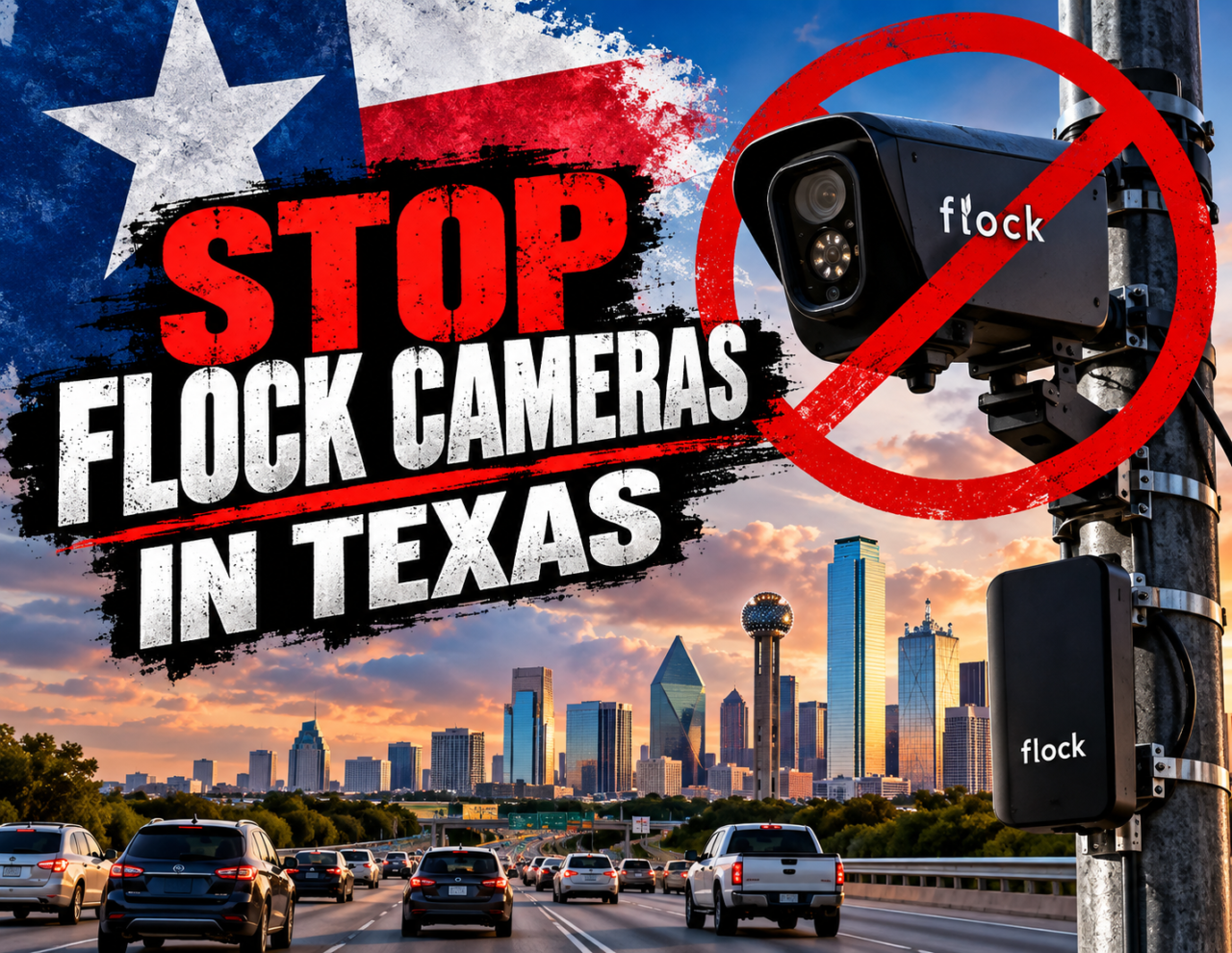
As a candidate for the United States Senate from Texas, I believe public safety is a fundamental responsibility of government. But protecting Texans from crime does not require building a system capable of recording and searching the movements of millions of people who have done nothing wrong.
That is why I support Texas cities and law-enforcement agencies terminating their agreements for Flock Safety automated license plate reader cameras and replacing these systems with investigative tools that are more targeted and subject to stronger public oversight.
Automated license plate readers, commonly called ALPRs, photograph passing vehicles and convert information about them into searchable data. According to Flock Safety’s own policy, its system can collect a license plate image, vehicle image and characteristics, plate number and state, date and time, and camera location.
That means these cameras do more than simply “take pictures.”
When deployed across communities, they can create records showing where vehicles were observed and when.
Texas Should Draw a Line on Mass Surveillance
There is an important distinction between investigating a crime and continuously collecting information about the public in case that information becomes useful later.
If police are investigating a robbery, kidnapping, stolen vehicle, or other serious crime, they should have effective investigative resources. But government surveillance should be focused on legitimate investigations rather than routinely collecting information about thousands of innocent motorists.
The question Texans should ask is simple:
How much information should the government collect about people who are not suspected of committing a crime?
My answer is: as little as reasonably necessary.
Flock says its standard retention period for license-plate-reader data is now seven days and that data is hard-deleted afterward, subject to customer agreements and applicable laws or policies. The company also says searches are auditable and that customers control access to their data.
Those safeguards deserve to be acknowledged. But shorter retention does not resolve my larger concern: the government is still creating a searchable record of ordinary people’s vehicles and locations without individualized suspicion.
Texas Is Already Positioned to Expand This Technology
This is not a hypothetical issue for our state.
The Texas Department of Information Resources currently lists an active statewide procurement contract with Flock Group Inc. The contract allows Texas state and local governments, public education institutions, and other public entities to purchase Flock hardware, software, and services through the state contract.
I believe Texas should move in the opposite direction.
Rather than making widespread vehicle surveillance easier to purchase and deploy, we should establish strong statewide protections governing automated surveillance technology.
Privacy Should Not Depend on Your ZIP Code
A Texan should not have dramatically different privacy protections simply because he or she crosses from one municipality into another.
One city might deploy dozens of cameras. Another might deploy hundreds. Different agencies can establish different policies concerning access, retention, sharing, and auditing.
That patchwork approach becomes increasingly problematic as surveillance networks grow.
Flock itself acknowledges that its ALPR data includes the location and time at which a vehicle was observed.
Individually, one observation may reveal very little. A large collection of observations can reveal considerably more about a person’s movements.
That is precisely why Texans should have this debate **before** these systems become permanent pieces of public infrastructure.
There Are Also Questions About Control of the Data
In April 2026, the ACLU raised concerns about changes to Flock’s contractual terms, including provisions it argues give the company significant control over how customers access data and a continuing license to use certain customer data to support and improve its services.
Flock presents a different view. The company states that customers retain ownership and control of their data, that it does not sell customer data, and that its systems include access controls and auditing mechanisms.
Texans should examine both sides of that dispute.
But there is an even simpler solution: government should minimize the amount of information it collects about innocent people’s movements in the first place.
The strongest protection against misuse of a surveillance database is not creating an unnecessarily broad database.
My Proposed Approach for Texas
I support a statewide policy that would phase out municipal reliance on Flock’s networked automated license plate reader systems and establish stronger rules for government surveillance technology.
Under the policy I support:
- Existing municipal Flock agreements should be reviewed and terminated in accordance with their lawful termination provisions rather than automatically renewed.
- Texas should stop facilitating new purchases of networked mass-surveillance ALPR systems by municipalities and state agencies.
- Any replacement technology should be narrowly tailored to specific public-safety purposes instead of creating a general database of motorists’ movements.
- Law-enforcement access to vehicle-location information should be tied to clearly defined investigative purposes and meaningful oversight.
Cities should disclose surveillance contracts, costs, retention policies, data-sharing arrangements, and audit information to the public and Texas should establish uniform statewide privacy protections so constitutional and privacy safeguards do not change every time someone crosses a city boundary.
And where surveillance technology is genuinely necessary for a particular investigation, government should use the least intrusive method reasonably available.
Public Safety and Civil Liberties Are Not Opposites
Supporters of automated license plate readers argue that they can help law enforcement locate stolen vehicles, identify vehicles connected to crimes, and generate investigative leads. Flock describes those public-safety applications as central purposes of its technology.
Those arguments should be part of the debate.
But technology being useful does not automatically mean government should deploy it everywhere.
A surveillance system can help solve crimes and still raise legitimate questions about privacy, oversight, data sharing, and the appropriate limits of government power.
Texas has always valued individual liberty and limited government. Those principles should apply in the digital age just as strongly as they have in the physical world.
Texans Should Not Have to Sacrifice Privacy to Drive Down a Public Road
Technology is advancing faster than many of the laws governing it.
Government therefore has a responsibility to establish boundaries before extraordinary surveillance capabilities become ordinary.
I do not want Texas to become a place where every trip to work, school, church, a political meeting, a doctor’s office, or a friend’s home potentially contributes to a government-searchable history of someone’s movements.
We can give law enforcement the resources necessary to investigate serious crimes without treating every driver as someone whose movements should routinely be recorded.
As a candidate for the Senate from Texas and New America, I support stronger limits on government surveillance and a statewide move away from municipal Flock camera agreements.
Public safety matters. Privacy matters. Constitutional liberty matters.
Texas can protect all three.
