
America’s tax system should reward hard work, entrepreneurship, and investment—but it should not provide one set of rules for ordinary Americans and another for the ultra-wealthy.
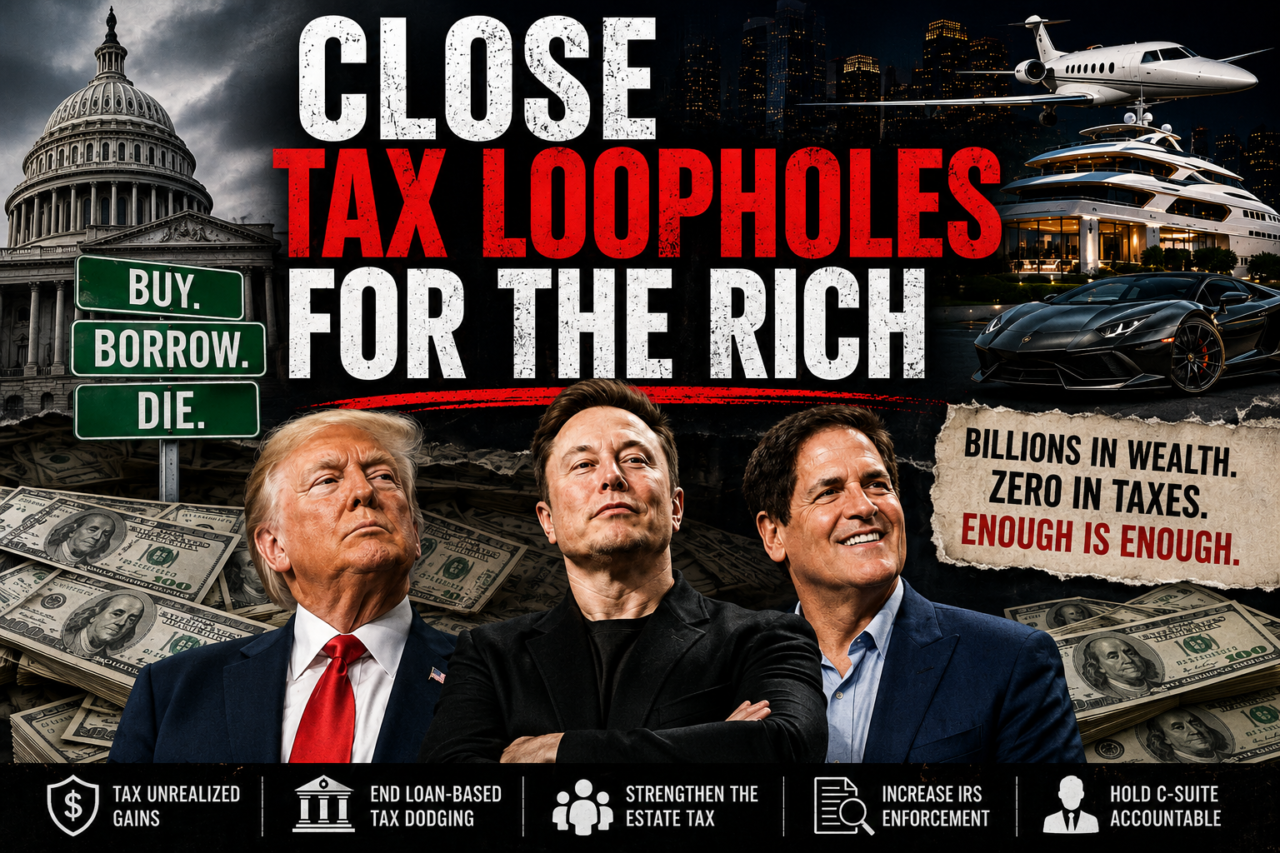
One of the clearest examples is a tax-planning strategy commonly known as Buy, Borrow, Die. The strategy can allow extremely wealthy individuals to accumulate appreciating assets, borrow against those assets rather than sell them, and ultimately transfer appreciated property to heirs while potentially avoiding substantial capital-gains taxes.
As a candidate for the U.S. Senate, I believe Congress should examine and close loopholes that allow enormous fortunes to grow while escaping taxation that working Americans cannot similarly avoid.
What Is Buy, Borrow, Die ?
The basic strategy has three parts.
Buy: Wealthy investors acquire assets such as stocks, businesses, and real estate. As those assets increase in value, the owner becomes wealthier. Under the current system, increases in an asset’s value generally are not subject to federal capital-gains tax until the asset is sold.
Borrow: Instead of selling appreciated assets and potentially triggering capital-gains taxes, a wealthy individual can borrow against them. The loan provides cash that can be used for living expenses, investments, or major purchases. Because loan proceeds generally are not considered taxable income, borrowing can provide access to wealth without creating the same tax liability that selling an appreciated asset could create.
Die: When appreciated assets are transferred at death, current federal tax law generally provides heirs with a new tax basis based on the property’s fair market value at the date of death, subject to applicable rules and exceptions. This is commonly called a **step-up in basis**. As a result, appreciation that occurred during the original owner’s lifetime may never be subject to capital-gains tax.
Each of these provisions has legitimate purposes when considered individually. But when they are combined strategically by people with enormous amounts of wealth, they can create opportunities to minimize taxes in ways unavailable to most Americans.
Why This Matters to Working Families
Most Americans cannot structure their finances this way.
Workers receive a paycheck, and income taxes are generally withheld before they ever receive their money. Small-business owners pay taxes on business income. Families pay payroll taxes, property taxes, sales taxes, and other expenses while trying to save for retirement, education, housing, and emergencies.
Someone whose wealth consists primarily of appreciating investments can be in a very different position.
A billionaire does not necessarily need a billion-dollar salary to live like a billionaire. If most of that person’s wealth is held in appreciating assets, borrowing against those assets can provide substantial cash without requiring the assets to be sold.
That distinction raises an important policy question: Should access to enormous economic wealth be treated so differently from income earned through work?
I believe Congress should confront that question.
How I Would Fight Tax Avoidance in the Senate
Closing tax loopholes does not mean attacking success or discouraging investment. America should remain a country where people can build businesses, create jobs, invest, and become financially successful.
The goal should be to prevent sophisticated tax strategies from giving the wealthiest households advantages that ordinary taxpayers cannot realistically access.
As Senator, I would support examining several reforms.
Reform the Treatment of Extreme Unrealized Gains
Congress should consider reforms aimed specifically at extremely wealthy households whose fortunes consist largely of unrealized investment gains.
Any proposal must be carefully designed. Small businesses, farms, retirement accounts, and ordinary homeowners should not be unintentionally harmed by rules designed for billionaires and extraordinarily wealthy investors.
The focus should remain where it belongs: enormous concentrations of wealth and sophisticated tax-avoidance strategies.
Address Loan-Based Tax Avoidance
Borrowing money is not normally income, and there are good reasons for that principle. A mortgage, business loan, or car loan obviously should not suddenly become taxable income.
But Congress should investigate whether extremely wealthy taxpayers are using massive loans secured by appreciated assets primarily as substitutes for realizing taxable gains.
We should be capable of distinguishing ordinary borrowing from sophisticated strategies specifically structured to avoid taxation.
Reform the Step-Up in Basis Rules
The step-up in basis deserves serious examination when it allows very large amounts of investment appreciation to escape capital-gains taxation permanently.
Reform does not have to mean eliminating reasonable protections for ordinary inheritances.
Congress can establish generous exemptions protecting family homes, farms, small businesses, and ordinary estates while creating stronger rules for exceptionally large fortunes.
Strengthen Enforcement Against Complex Tax Avoidance
Tax laws mean little without effective enforcement.
The federal government needs the expertise and resources necessary to investigate sophisticated tax arrangements involving complicated partnerships, trusts, corporations, offshore structures, and enormous investment portfolios.
Enforcement should focus on serious tax evasion and complex abusive schemes—not unnecessary harassment of ordinary taxpayers and small businesses.
Corporate Executives Must Be Accountable Too
Tax reform should also include greater accountability at the highest levels of corporate America.
CEOs and other C-suite executives make decisions involving billions of dollars, thousands of employees, shareholders, consumers, and communities. When executives knowingly participate in fraudulent accounting, illegal tax schemes, or deliberate financial misconduct, responsibility should not simply disappear inside the corporate structure.
Congress should strengthen transparency requirements, improve enforcement against deliberate corporate tax abuse, and ensure that executives who knowingly authorize illegal conduct can be held personally accountable where appropriate.
Corporate leadership should come with corporate responsibility.
This Is About Fairness, Not Punishment
There is nothing wrong with becoming wealthy.
Successful entrepreneurs can create jobs, develop technologies, build companies, and contribute enormously to the economy. Investment itself is essential to economic growth.
The problem arises when the tax code becomes so complicated that access to the right lawyers, accountants, financial institutions, and financial structures can produce dramatically different outcomes for people with extraordinary wealth.
A nurse cannot borrow millions against a stock portfolio instead of receiving taxable wages.
A teacher cannot structure a paycheck as an unrealized capital gain.
A construction worker cannot simply decide that this year’s wages will remain untaxed until some future date.
The rules should recognize these differences.
A Tax Code People Can Believe In
Tax policy can be complicated, but the principle behind reform should be simple:
People who prosper the most from America’s economy should contribute fairly to maintaining the country that makes that prosperity possible.
That means supporting infrastructure, education, public safety, scientific research, national defense, and the other institutions upon which a functioning economy depends.
Closing abusive loopholes can also help Congress address deficits and fund national priorities without continually turning to working families for additional revenue.
As Senator, I would work toward a tax system that encourages investment and entrepreneurship while refusing to accept a system in which enormous fortunes can use increasingly sophisticated strategies to avoid taxation indefinitely.
Buy. Borrow. Die.
It may be a clever tax strategy.
But clever accounting should not determine who carries America’s tax burden.
It’s time to close unfair loopholes, demand accountability, and build a tax system in which success is rewarded—but everyone plays by fair rules.
